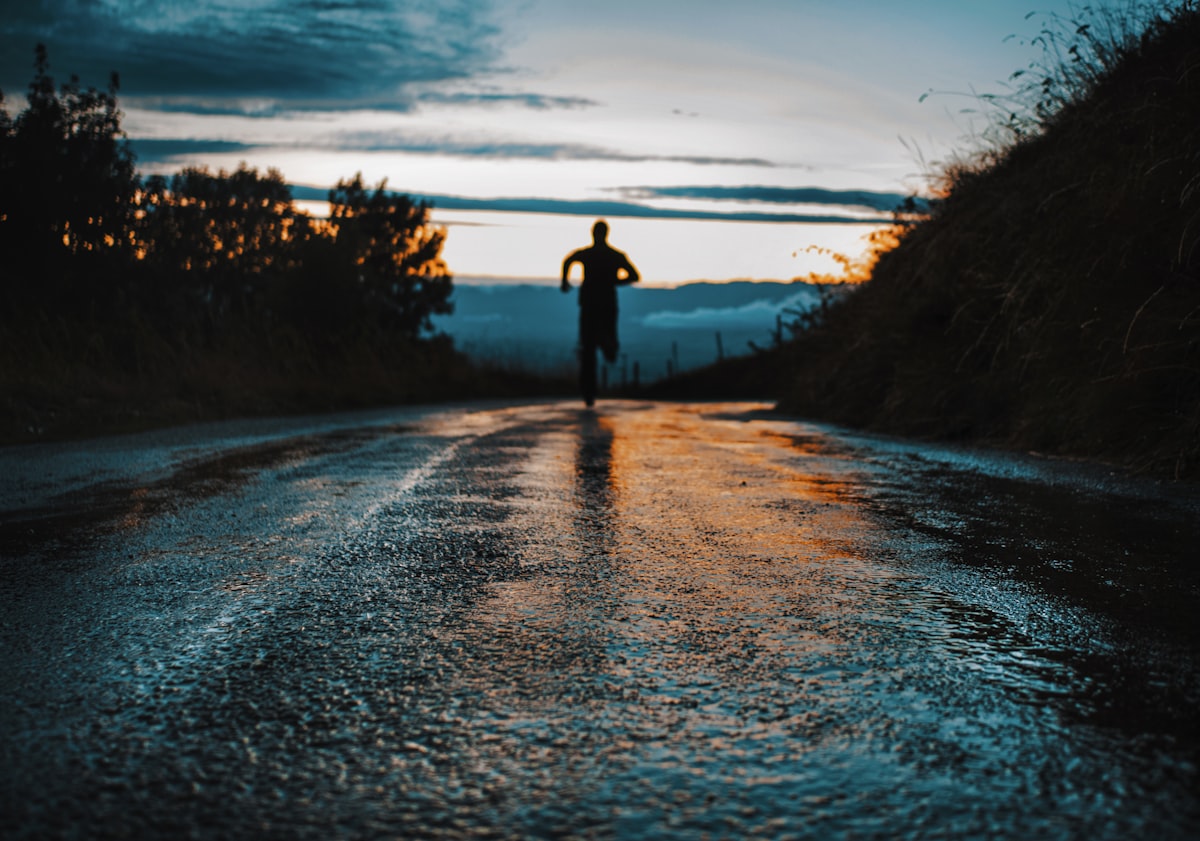
Photo by Lucas Favre on Unsplash
Yesterday there was a 10-mile run on my calendar.
When I stepped out at Marymoor, the sky was heavy and already raining. It matched how I had been feeling for a while—uncertain, a little dull inside, and carrying questions I didn’t know how to answer.
I didn’t feel heroic or particularly motivated. I just knew that not going would add one more layer of restlessness. So I started running, slowly, without expecting anything special from the day.
The first few miles were crowded—not on the path, but in my mind. Thoughts about work, direction, and “what am I really doing?” kept circling. None of it was dramatic, just a steady background noise of doubt and low-grade anxiety. I noticed how quickly I wanted some other version of reality: clearer answers, better weather, a lighter heart.
This is exactly the pattern Vipassana points to—craving what is not here, pushing away what is here, and getting quietly exhausted by that tug-of-war. On the cushion, I have heard the instruction so many times: observe sensations, see them arise and pass, do not react with craving or aversion. Out there in the rain, I could see the same habit showing up in ordinary life, and also how often I still get pulled into it.
Sometime before the halfway point, a simple, almost boring realization came: this run is going to be in the rain. Not later, not differently—just like this. I didn’t feel any sudden insight or joy; it was more like a small inner nod. The moment I stopped waiting for different conditions, the experience softened a little on its own.
At around mile five, I paused briefly.
Water. A gel. One slower breath.
When I turned back, the sky began to shift. The rain didn’t stop all at once, but it lightened. Some clouds opened. A bit of sun came through. It wasn’t a grand moment—just a quiet change in the same sky I had been under the whole time.
What stayed with me was not that the sun appeared, but how quickly the mind wanted to make a story out of it: “Now the real run begins. Now it’s good.” The same old habit of dividing life into good and bad, worthy and unworthy. Vipassana and the teachings I’ve heard keep pointing out how this very division, this constant choosing and rejecting, is what keeps suffering alive.
The Gita speaks of steadiness in sukha and dukha, gain and loss, success and failure—a kind of gentle evenness in the middle of all changes. I am nowhere close to that equanimity, but for a few miles I could see my distance from it very clearly. I saw how much I still depend on “good weather,” inside and outside, to feel okay, and how easily I lose balance when things don’t match my preferences.
The last stretch of the run was not faster or more impressive. If anything, my legs were tired. But the inner tone had shifted slightly, at least for a while. Instead of trying to fix my life in my head, I was mostly noticing: the feel of wet shoes, the contrast when the sun touched my skin, the way thoughts kept rising and fading without any real solidity. It was a small, very ordinary taste of what Vipassana calls observing without interfering—letting sensations and thoughts do what they do, while I simply remain aware as best I can.
Nothing important was resolved by the time I finished. The bigger questions—about work, direction, and what truly matters—are all still open. There was no sense of having “achieved” anything. What I did feel, very quietly, was a bit more honesty with myself: I saw my craving for certainty, my resistance to discomfort, and my tendency to postpone peace until conditions improve.
If there was any gift from those ten miles, it was this: a reminder that life will keep moving through different weathers, and that my work is not to control the sky, but to meet each moment with a little more awareness and a little less struggle. On most days I fall short of that, but even a brief glimpse feels worth remembering.
Comments